Foundation
Wales
Wales is one of the four nations of the United Kingdom. Its primary visual foundation is Y Ddraig Goch — the red dragon — usually shown on a white and green field and widely recognised as a symbol of Wales and Welsh identity.
This page collects the primary Welsh asset with practical notes on naming, specification, context, common use and common mistakes.
Primary asset — Y Ddraig Goch
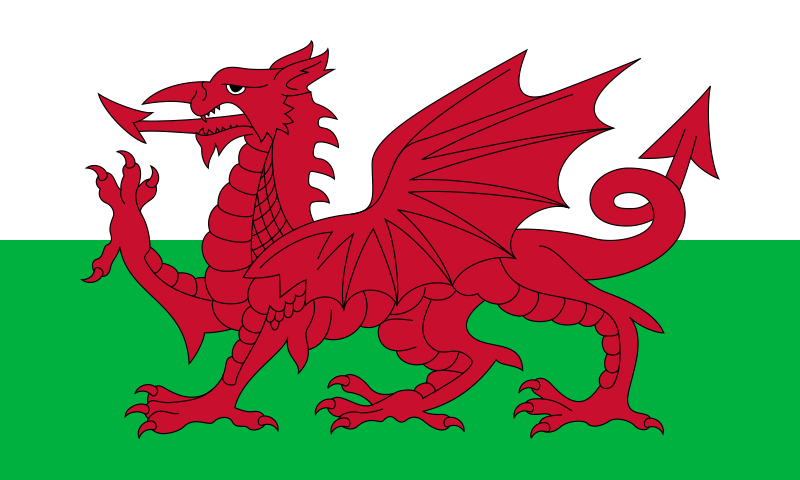
Y Ddraig Goch is the Welsh-language name and the primary designation. The English description "The Red Dragon of Wales" is commonly used. Welsh-language naming matters in Welsh contexts and should not be omitted where appropriate. The SVG above is a schematic representation — for production use, refer to an authoritative official source.
Note: This SVG is a schematic representation. The exact form of the dragon is not publicly standardised in a freely available specification. For authoritative production use, source the artwork from an official Welsh Government or recognised heraldic authority.
Specification and construction
| Asset name | Y Ddraig Goch |
|---|---|
| English description | The Red Dragon of Wales |
| Represents | Wales |
| Ratio | 3:5 (height to width) |
| Dragon red |
Pantone 186 C · #C8102E RGB 200, 16, 46 · CMYK 0, 91, 76, 6 |
| Upper field | #FFFFFF — White (Tudor livery) |
| Lower field |
Pantone 354 C · #00703C RGB 0, 112, 60 |
| Dragon posture | Passant — walking, right forepaw raised, facing dexter (right as seen on the flag) |
| Dragon form | The current flag was recognised in 1959. The exact dragon form is not treated here as a legally standardised public construction specification; use official or production artwork where precision matters. |
| Officially adopted | Current design recognised by Royal Warrant, 1959 |
| Statutory basis | Royal Warrant 1959. The Schedule specifies the dragon's form. |
Meaning and context
Y Ddraig Goch is among the oldest national symbols in Europe. The red dragon has been associated with Wales for centuries, appearing in Welsh mythology and mediaeval legend. It was used as a royal badge by the Tudor dynasty — Henry VII's dynastic badge was the red dragon, reflecting his Welsh ancestry — and this connection to the Tudor livery explains the white and green field.
The current form of the flag, with Y Ddraig Goch passant on a horizontally divided white and green field, was formally recognised by Royal Warrant in 1959. This was the first time the flag was formally adopted in its current configuration by royal authority.
The flag is a strongly recognised symbol of Welsh identity. Welsh-language naming is significant: Y Ddraig Goch is the primary designation, and in Welsh contexts, using the Welsh name is appropriate and expected. Wales should not be reduced to generic "Celtic" styling — Y Ddraig Goch belongs specifically to Wales.
Wales is absent from the Union Flag. This is not an oversight. Wales was incorporated into England under the Laws in Wales Acts 1535–1542, predating both the 1606 and 1801 versions of the Union Flag. There has been ongoing discussion about incorporating Welsh representation into the Union Flag, but no change has been made.
Naming and terminology
Wales is one nation of the United Kingdom; Welsh is the standard adjective.
Cymru (Wales) and Cymraeg (Welsh language) should be used accurately in bilingual and Welsh-language contexts.
Y Ddraig Goch and The Red Dragon refer to the Welsh flag; in Welsh-language contexts, Welsh naming should not be treated as decorative filler.
Common usage
Welsh sport
Primary flag for Wales national teams in football, rugby union, cricket and other sports where Wales competes separately.
Civic and cultural events
St David's Day (1 March), the National Eisteddfod, civic events and Welsh national occasions.
Tourism
Central to Welsh tourism identity and destination marketing — domestic and international.
Exports and Welsh-made
Used to signal Welsh origin or provenance on Welsh products — food, crafts, manufacturing and cultural goods.
Welsh-language contexts
Y Ddraig Goch and Welsh-language naming appear across Welsh Government communications, Senedd Cymru materials and bilingual public contexts.
Place-specific representation
Where Welsh regional or national identity is relevant — Welsh organisations, Welsh-specific events and Welsh cultural representation internationally.
Common mistakes
Using low-quality, badly simplified or incorrectly proportioned dragon artwork. The dragon is a complex heraldic figure — poor simplifications are immediately obvious and undermine the flag's character.
Stretching or squashing the flag or the dragon. The 3:5 proportion should be respected. The dragon occupies the field in a specific way — distorting the frame distorts the dragon.
Omitting Welsh-language naming where it matters. In Welsh contexts — Welsh Government communications, Senedd materials, Welsh cultural events — Y Ddraig Goch is the appropriate name, not just "the Welsh dragon".
Treating Wales as generic Celtic styling. Y Ddraig Goch belongs specifically to Wales. Using it to evoke a general Celtic, Irish, Scottish or "Northern" identity is a misuse and is inaccurate.
Using the Union Flag when Wales is specifically meant. For Welsh sport, Welsh civic occasions or Welsh-specific representation, Y Ddraig Goch is the appropriate flag.
Using England or Britain language when Wales is the actual subject. Wales, England, Scotland and the United Kingdom are distinct. The distinction matters in naming, flag choice and communication.
Provenance and source notes
| Primary source | The Flag Institute — flaginstitute.org. |
| Statutory authority | Royal Warrant 1959 — formally recognised the current design, including the dragon's form as set out in the Schedule |
| Dragon specification | The current flag was recognised in 1959. The exact dragon form is not treated here as a legally standardised public construction specification; use official or production artwork where precision matters. |
| Colour authority | Pantone references follow the Flag Institute Registry: Red 186 and Green 354. HEX/RGB values are practical digital/SVG references and should be checked for production use. |
| SVG status | Schematic representation only. Not a reproduction of the official Royal Warrant Schedule design. Not recommended for formal, official or production use without independent verification. |
| Last reviewed | May 2026 |
Downloads and references
Downloads
This SVG is a schematic representation. For official or production use, source artwork from the Welsh Government or a recognised heraldic authority.
References
- The Flag Institute Flag specifications, history and guidance
- Welsh Government Official Welsh Government — source for authoritative flag artwork and colour guidance
- Flags of the World — Wales Cross-reference for construction and historical notes
Related pages
- Foundations indexOverview of all foundation entries and supporting guidance
- LanguageNaming and terminology guidance
- ColoursRelated colour references and context notes
- Assets: FlagsDownload available UK and nation flag files
- United KingdomUK-wide foundation context
- EnglandEngland foundation page
- ScotlandScotland foundation page
- WalesWales foundation page
- Northern IrelandContext-dependent symbol guidance