Foundation
United Kingdom
The United Kingdom is a sovereign state made up of England, Scotland, Wales and Northern Ireland. Its visual foundations are used across government, diplomacy, sport, culture, tourism, exports and commercial shorthand for British identity.
This page collects the main UK-wide visual references, with the Union Flag as the primary asset and practical notes on naming, use, specification and context.
Primary asset — Union Flag
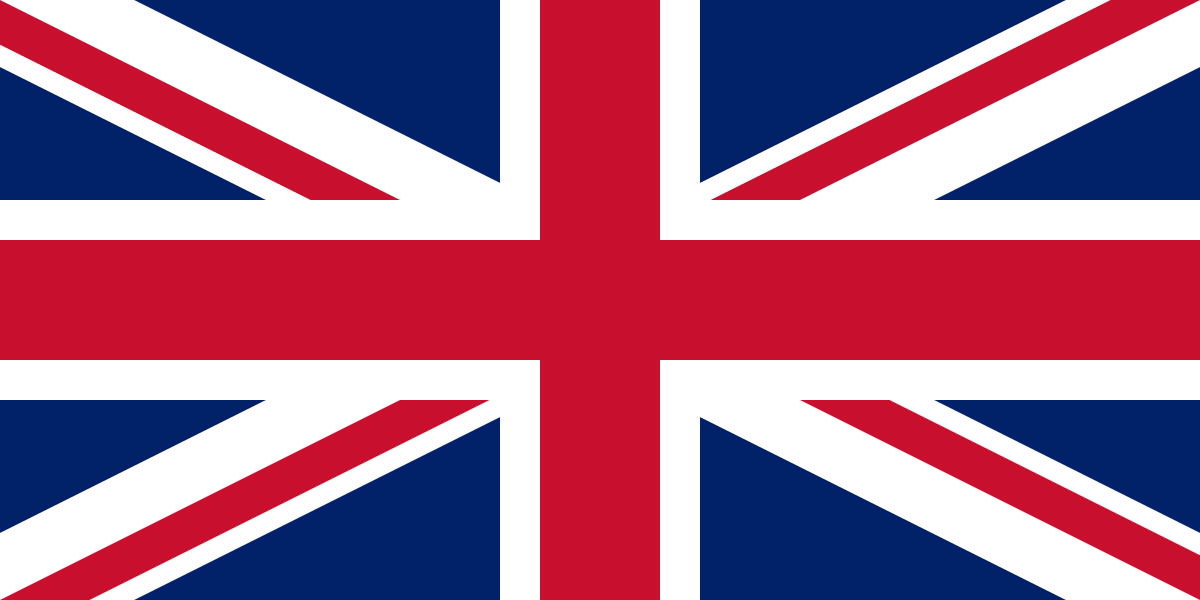
Union Flag is the formal name. Union Jack is widely used and commonly understood — especially in everyday speech — and is not wrong. This site uses Union Flag for formal labelling and Union Jack where common usage is more natural.
Specification and construction
| Formal name | Union Flag |
|---|---|
| Common name | Union Jack |
| Represents | United Kingdom |
| Ratio | 1:2 (height to width) |
| Blue |
Pantone 280 C · #012169 RGB 1, 33, 105 · CMYK 100, 72, 0, 18 |
| Red |
Pantone 186 C · #C8102E RGB 200, 16, 46 · CMYK 0, 91, 76, 6 |
| White | #FFFFFF · No Pantone specification |
| Construction | Combines the crosses of St George (England), St Andrew (Scotland) and St Patrick (Ireland) |
| Cross width | St George's cross: 1/5 of flag height, with 1/15 white fimbriation each side |
| Saltire width | 1/3 of flag height (white) · 1/5 of flag height (red counterchange) |
| Orientation | Not vertically symmetrical — the offset red diagonals mean the flag has a correct way up |
| Statutory basis | None — the design is governed by longstanding practice, not legislation |
View construction sheet (Wikimedia Commons) →
Meaning and context
The Union Flag brings together historic national crosses and is commonly used as a visual shorthand for the United Kingdom and British identity. It is useful where a broad UK-wide cue is needed, but it should not replace nation-specific symbols where England, Scotland or Wales are the actual subject.
The flag was created in 1606, when King James VI of Scotland became James I of England and the Scottish and English crowns were united. The original design combined only the crosses of St George and St Andrew. The current form dates from 1801, when the Acts of Union 1800 united Great Britain with Ireland and the cross of St Patrick was added. Wales is absent because Wales had already been incorporated into England under the Laws in Wales Acts 1535–1542, predating the first Union Flag by over half a century.
No statutory design basis. The current design is used by proclamation/tradition and is documented by recognised flag authorities.
Naming and terminology
United Kingdom is the formal state name. UK is the standard short form.
Great Britain means England, Scotland and Wales only. Britain is common shorthand but can be ambiguous in precise contexts.
British is generally appropriate for UK-wide state, citizenship and national references.
Union Flag is the formal asset name; Union Jack is the common and accepted name.
Common usage
UK-wide visual foundations are appropriate when a broad British or United Kingdom cue is needed. The Union Flag is not always the right asset — where a specific nation is the subject, a nation-specific symbol is usually more accurate.
Government and civic
Flown from government buildings, used across official communications, state occasions and public-facing government materials.
Diplomacy
Standard diplomatic identifier for the UK abroad — on vehicles, at summits, in treaty contexts and at international institutions.
Sport
Used for UK-wide teams (Paralympics GB, British & Irish Lions) and at pan-national events. Individual nations use their own flags in most sports.
Tourism
Widely used in destination marketing and tourism contexts where Britain as a whole is being promoted, particularly overseas.
Exports and British-made
A common shorthand for British origin, quality or provenance on product labels, packaging and commercial communications.
Events and campaigns
National events, public celebrations, commemorations and national campaigns often use the flag as the primary UK-wide visual anchor.
Commercial shorthand
One of the most commercially referenced national flags. No licence is required for its general commercial use.
Common mistakes
Using the Union Flag when England, Scotland or Wales is specifically meant. The Union Flag represents the United Kingdom — not England. The flag of England is St George's Cross.
Confusing Great Britain with the United Kingdom. Great Britain is the island comprising England, Scotland and Wales. The United Kingdom includes Northern Ireland. The Union Flag is the flag of the United Kingdom.
Displaying the flag upside down. The flag is not symmetric — the broad white diagonal must run from bottom-left to top-right at the hoist. An inverted flag is a recognised distress signal and is considered offensive in formal contexts.
Assuming the flag is vertically symmetrical. The counterchange on the St Patrick's saltire means top and bottom are not mirror images. A symmetric rendering is a construction error.
Using a square or non-standard aspect ratio. The correct proportion is 1:2. Squarish reproductions distort the cross widths and change the visual balance.
Cropping the flag in a way that damages recognition or implies incorrect orientation. Off-centre crops can make a correct flag appear to be displayed wrongly.
Using incorrectly constructed artwork — particularly centred (non-counterchanged) diagonals, or colour values that do not match Pantone specifications.
Insisting "Union Jack" is always wrong. It is the widely understood common name and is not incorrect — in everyday speech and informal use it is entirely acceptable.
Provenance and source notes
| Primary source | The Flag Institute — flaginstitute.org |
| Colour authority | Recommended colours follow the Flag Institute specification. The College of Arms notes that heraldic colours are not fixed in law, provided the red and blue are clearly identifiable. |
| Construction reference | Wikimedia Commons construction sheet — useful for reference; underlying source should be verified for production use |
| Statutory basis | None — the design is governed by longstanding practice, not legislation |
| Current form since | 1 January 1801, following the Acts of Union 1800 |
| Previous form | 1606 — St George and St Andrew crosses only; no St Patrick's saltire |
| SVG status | Constructed from published specifications with correct counterchange offset. The flag itself is not subject to copyright. This rendering is released under Open Government Licence v3.0 |
| Last reviewed | May 2026 |
Downloads and references
Downloads
Only assets that Great British Brand is providing directly. The SVG uses correct 1:2 proportions with accurate counterchange offset.
References
- The Flag Institute Specifications, guidance and flag history
- Construction sheet Wikimedia Commons construction diagram
- Flying flags — GOV.UK guidance UK Government plain-English guide to flag flying
Related pages
- Foundations indexOverview of all foundation entries and supporting guidance
- LanguageNaming distinctions for UK, Great Britain, Britain and national terms
- ColoursCross-reference colour guidance for consistent digital usage
- Assets: FlagsDownload panel for available UK and nation flag files
- EnglandNation-specific foundation page
- ScotlandNation-specific foundation page
- WalesNation-specific foundation page
- Northern IrelandContext-dependent symbol and naming guidance