Foundation
England
England is one of the four nations of the United Kingdom. Its most direct visual foundation is the St George's Cross — a red cross on a white field — widely used across sport, civic identity, national days, events and English place-based representation.
This page collects the primary English asset with practical notes on naming, specification, context, common use and common mistakes.
Primary asset — St George's Cross
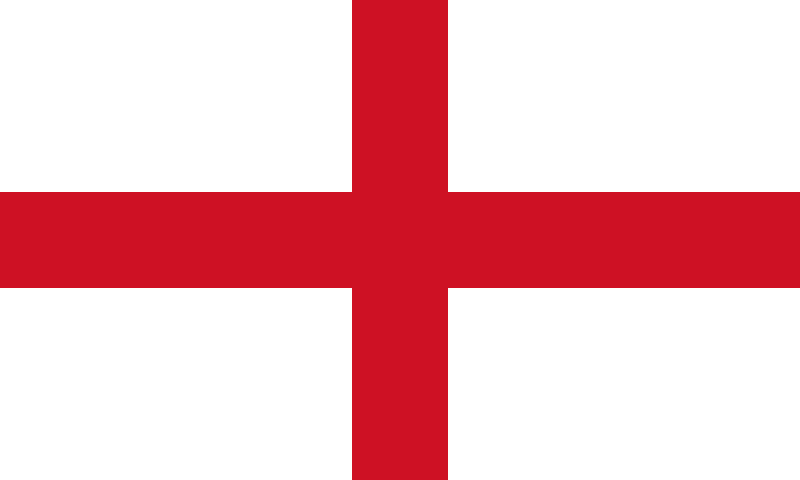
The recognised flag of England. St George's Cross also appears as a component within the Union Flag as the cross of St George. When used in isolation it represents England specifically — not Britain or the United Kingdom.
Specification and construction
| Asset name | St George's Cross |
|---|---|
| Represents | England |
| Ratio | 3:5 (height to width) — registered Flag Institute proportion for this reference. |
| Red |
Pantone 186 C · #C8102E RGB 200, 16, 46 · CMYK 0, 91, 76, 6 |
| White | #FFFFFF · No Pantone specification |
| Cross width | 1/5 of flag height — the widely accepted standard, as documented by the Flag Institute. No fimbriation. |
| Construction | Plain red cross on a white field. No border, no fimbriation, no additional elements. |
| Statutory basis | None — no formal statutory specification exists for St George's Cross |
Meaning and context
St George's Cross is the recognised flag of England. Its association with England dates from the mediaeval period — the cross was used as a military and maritime symbol by at least the 13th century, and St George became patron saint of England under Edward III in the 14th century.
The cross is embedded in the Union Flag as the cross of St George, but when displayed on its own it represents England specifically. It should not be used when Britain or the United Kingdom is the intended subject — that is the role of the Union Flag.
The flag is widely used in English sport, civic contexts, St George's Day events and English place-based representation. Its use has increased significantly since the 1990s, driven largely by football tournament identity.
Naming and terminology
England is one nation of the United Kingdom and should be named specifically when England is the subject.
Britain and United Kingdom are broader terms and should not be used as direct substitutes for England.
St George's Cross is England's flag; the Union Flag is UK-wide and should be used only when that level of identity is intended.
Common usage
English sport
Primary flag for England national teams in football, cricket, rugby union and other sports where England competes separately from the UK.
Civic events
Flown by some local councils and on civic buildings, particularly around St George's Day (23 April) and significant national occasions.
St George's Day
The flag is central to St George's Day observance and events marking England's patron saint.
English teams and organisations
Used by English-specific organisations, clubs and events to signal England — not Britain — identity.
Place-specific representation
Where English regional or national identity is relevant — English tourism, English-made products, English cultural events.
Heraldic use
St George's Cross appears in the arms of cities, counties and institutions across England with long heraldic history.
Common mistakes
Using England when Britain or the UK is actually meant. England is one of four nations. The Union Flag should be used where the United Kingdom as a whole is the subject.
Using the Union Flag when England specifically is meant. For English sport, English civic occasions or English-specific representation, St George's Cross is the appropriate flag.
Treating English and British as interchangeable. They are not. England is a nation within the UK; British refers to the UK as a whole. This distinction matters in both naming and flag choice.
Using a square or excessively wide crop. The standard proportion is 3:5. A cross that is too wide or too narrow relative to the field changes the character of the flag.
Cropping the flag so that the cross arms are unevenly cut, or so that the white field is almost entirely lost. Both reduce recognisability.
Using inconsistent reds that do not match the Pantone 186 C specification. The red should match the same value used in the Union Flag.
Using low-quality, pixelated or poorly constructed files, particularly at scale. The flag is simple enough that poor quality is especially visible.
Provenance and source notes
| Primary source | The Flag Institute — flaginstitute.org |
| Colour authority | Registered by the Flag Institute as a 3:5 national flag using White and Pantone Red 186. No formal statutory construction document has been confirmed for this reference. |
| Ratio | Registered 3:5 proportion in the Flag Institute England Flag Registry. No formal statutory construction document has been confirmed for this reference. |
| Cross width | 1/5 of flag height — consistent with Flag Institute documentation and crwflags.com reference |
| Statutory basis | None |
| SVG status | Constructed from published specifications. The flag itself is not subject to copyright. This rendering is released under Open Government Licence v3.0 |
| Last reviewed | May 2026 |
Downloads and references
Downloads
SVG uses 3:5 proportions with cross width at 1/5 of flag height, consistent with Flag Institute documentation.
References
- The Flag Institute Flag specifications, history and guidance
- Flags of the World — England Cross-reference for construction and proportion notes
Related pages
- Foundations indexOverview of all foundation entries and supporting guidance
- LanguageNaming and terminology guidance
- ColoursRelated colour references and context notes
- Assets: FlagsDownload available UK and nation flag files
- United KingdomUK-wide foundation context
- EnglandEngland foundation page
- ScotlandScotland foundation page
- WalesWales foundation page
- Northern IrelandContext-dependent symbol guidance